
Exam grading made easy: How to grade exams efficiently and fairly
The stack of exams keeps growing, deadlines are approaching, and the expectation for fair grading remains high. For instructors and academic staff, grading exams often becomes a balancing act between efficiency and accuracy, especially when a large number of assessments need to be reviewed. This article provides practical strategies for streamlining the grading process. Discover proven methods and digital tools that will help you grade exams faster, more consistently, and more transparently, while freeing up time for teaching and supporting students.
Common challenges in exam grading
Anyone who regularly grades exams or assessments is familiar with the typical challenges involved. The most obvious issue is the amount of manual work involved. Reading responses, adding comments, and calculating scores can be very time-consuming and exhausting.
This often leads to additional problems:

Inconsistencies
In large courses or when multiple graders are involved, inconsistencies can easily occur. The first exam graded may not be evaluated the same way as the fiftieth.

Subjective grading
Unconscious bias, fatigue, or even the grader’s mood can unintentionally influence decisions, affecting fairness.

Delays
Lengthy grading timelines create uncertainty for students and slow down administrative processes.
Modern digital assessment tools provide a future-ready solution by structuring, automating, and standardizing the grading workflow for everyone involved.
What should you consider when grading exams?
Effective exam grading is based on solid pedagogical and procedural principles. The goal is to provide a transparent and reliable evaluation of student performance, not simply to identify mistakes.
Principles of effective grading:

Fairness

Consistency and traceability

Transparency
Fair grading means evaluating every student under the same conditions and according to the same standards. Grading criteria should be clearly communicated in advance to ensure transparency. Students should also understand how their grade was determined, which is an important factor for meaningful learning outcomes.
Rubrics and grading criteria: The foundation of objective assessment
Rubrics and grading criteria are among the most effective tools for ensuring consistent evaluations, whether grading short quizzes or large-scale written exams. A strong rubric clearly defines what level of performance corresponds to each score in advance. It describes the different quality levels for each assessment criterion.
How to create a simple rubric:
- Define the criteria: Identify the most important aspects of the response (e.g., accuracy of content, quality of argumentation, and use of sources or references)
- Define performance levels: Describe what excellent, good, satisfactory, and insufficient performance looks like for each criterion.
- Assign point values: Allocate points to each performance level.
Analytic vs. holistic grading
- Analytic grading: In analytic grading, each criterion is evaluated separately, and the points are added together at the end. This method is highly transparent and easier to justify.
- Holistic grading: The holistic approach evaluates the response as an overall impression and assigns it to a predefined competency level. While this approach is faster, it can also be more subjective.
For most educational settings, analytic grading based on a clear rubric is the more reliable option.

Best practices for effective exam grading
Manual grading processes can become significantly more efficient and consistent with the right techniques. Structured workflows reduce grading time while improving the quality and fairness of feedback.
Avoid grading one entire exam at a time. Instead, grade the same question across all exams before moving on to the next one. This improves consistency and reduces the risk of shifting grading standards over time.
A full second review is often unrealistic. Instead, consider random spot checks where another instructor reviews a sample of exams to identify inconsistencies. Whenever possible, anonymize exams to minimize unconscious bias.
Many comments are repeated across multiple exams. Building a library of frequently used comments (comment bank) for common mistakes or strong responses saves time and creates more consistent feedback.
Use your rubric as a checklist throughout the grading process. Mark which criteria were met and assign points accordingly. This will structure your workflow and create a clear basis for student feedback.
Instead of relying solely on written comments, categorize recurring mistakes (e.g., weak argumentation, calculation error, incomplete explanation). This helps instructors and students quickly identify patterns and areas for improvement.
Benefits of digital and automated exam grading
Digital tools take grading efficiency and fairness to the next level. One of the greatest advantages is reducing manual work and human error. Manual score transfers between spreadsheets are unnecessary, and calculation errors are eliminated. For closed or standardized question types, scoring can even be fully automated.
This is where professional exam software like evaexam comes in. The platform supports the entire assessment lifecycle — from exam creation and delivery to grading and evaluation.

evaexam makes digital exam management simple, secure, and efficient. Educational institutions and organizations can reliably create, administer, and grade exams – either online or paper-based. Thanks to automated grading workflows, flexible exam formats, and ISO 27001-certified data security, evaexam saves valuable time while improving the fairness and transparency of the grading process. Universities, academies, and organizations across Europe rely on evaexam as a professional assessment solution.
Checklist: Steps for efficient and fair grading
- Define your rubric in advance: Create a detailed rubric with clear criteria and point values before grading begins.
- Establish consistent grading standards: Ensure all graders follow the same standards. Conduct a short calibration session using a small sample of exams.
- Use automated tools strategically: Leverage software for automatic scoring of closed questions and structured review of open-ended responses.
- Plan for quality assurance: Include second reviews or spot checks to ensure consistency across graders.
- Enable transparency and review: Make sure students can understand how their scores were determined and provide opportunities for review where appropriate.
What does the grading process look like with evaexam?
evaexam was designed specifically to address common grading challenges. The software combines intelligent automation with flexible tools for manual evaluation.
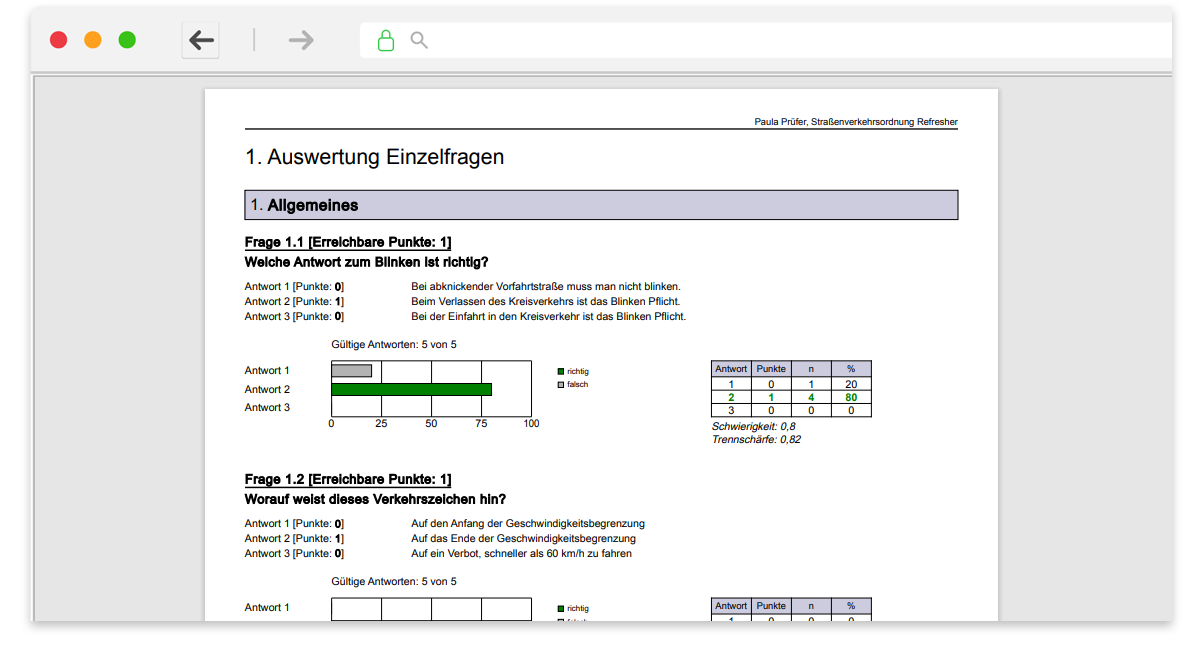
Automatic scoring for closed question types
Multiple choice, single choice, matching, and true/false questions are automatically scored immediately after submission – a major advantage for institutions handling large volumes of exams. Results are instantly available in detailed reports that include statistics and item analyses, such as the difficulty or discrimination index.
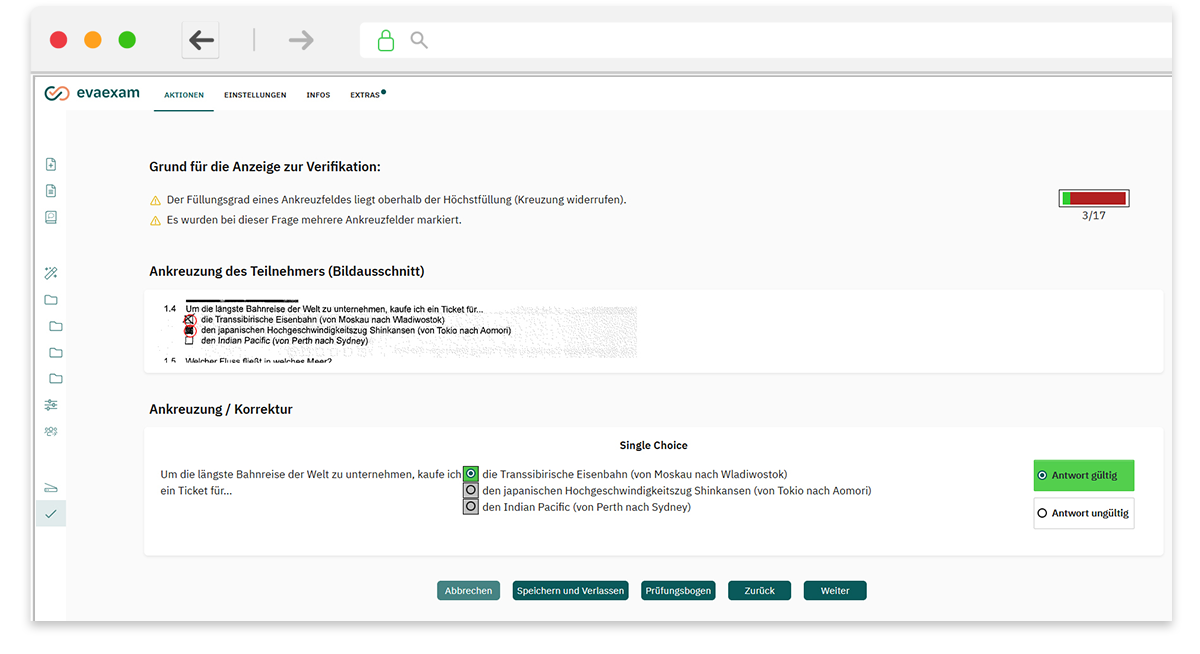
Clear and centralized grading environment
All responses and grading data are stored in one place. Paper-based exams can be scanned and graded digitally within the same environment. Multiple graders can work on different sections of the same exam simultaneously without conflicts.

Statistical analysis and quality assurance
Using item analysis, instructors can evaluate question quality based on metrics such as difficulty and discrimination. This helps identify weak or misleading questions early on and improves future assessments.
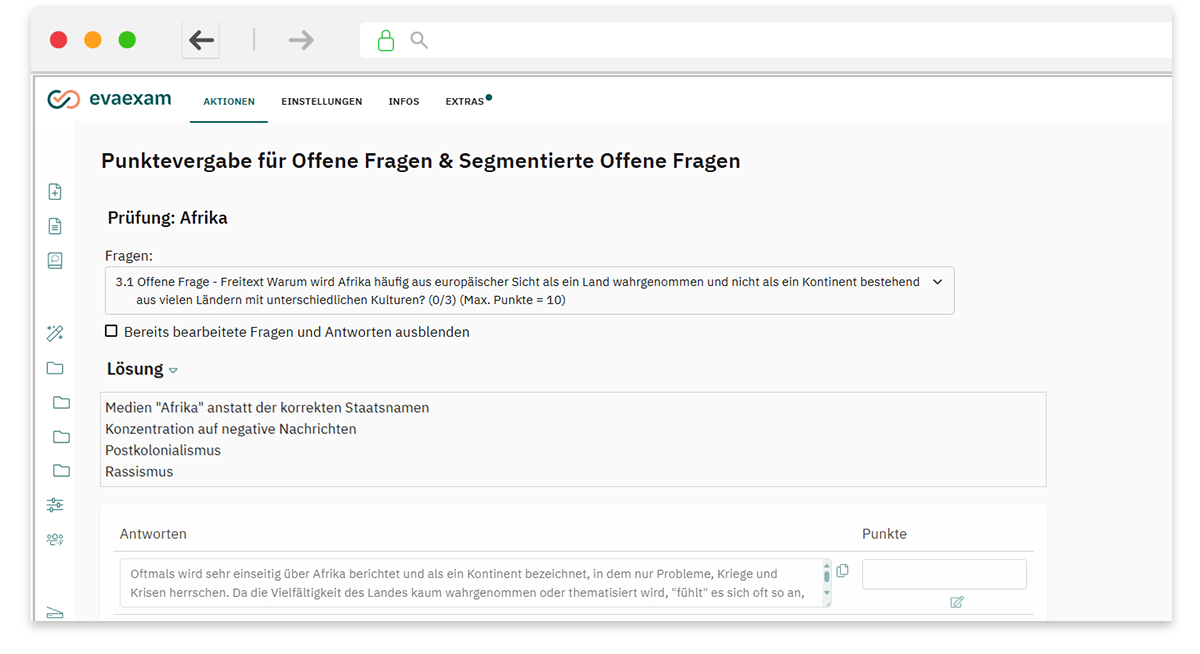
Structured evaluation of open-ended questions
Open-ended questions and free-text responses can be reviewed directly within the system. Graders can assign points, add comments, and use annotation tools to ensure consistent and transparent evaluation. Multiple graders can work simultaneously, making the process more efficient for large groups and complex assessments. These features exemplify how modern assessment platforms support educational institutions in providing scalable, reliable grading processes.
Improve your exam grading with clear processes and digital tools
Thoughtful exam grading is a critical part of effective teaching and learning, not just an administrative task. Institutions can create grading workflows that are faster, fairer, and more transparent by combining clear grading criteria, proven best practices, and digital tools like evaexam. This improves the quality of assessments and provides students with meaningful feedback.
Take your exam grading to the next level.
Discover how evaexam can support your institution and request a free demo today.